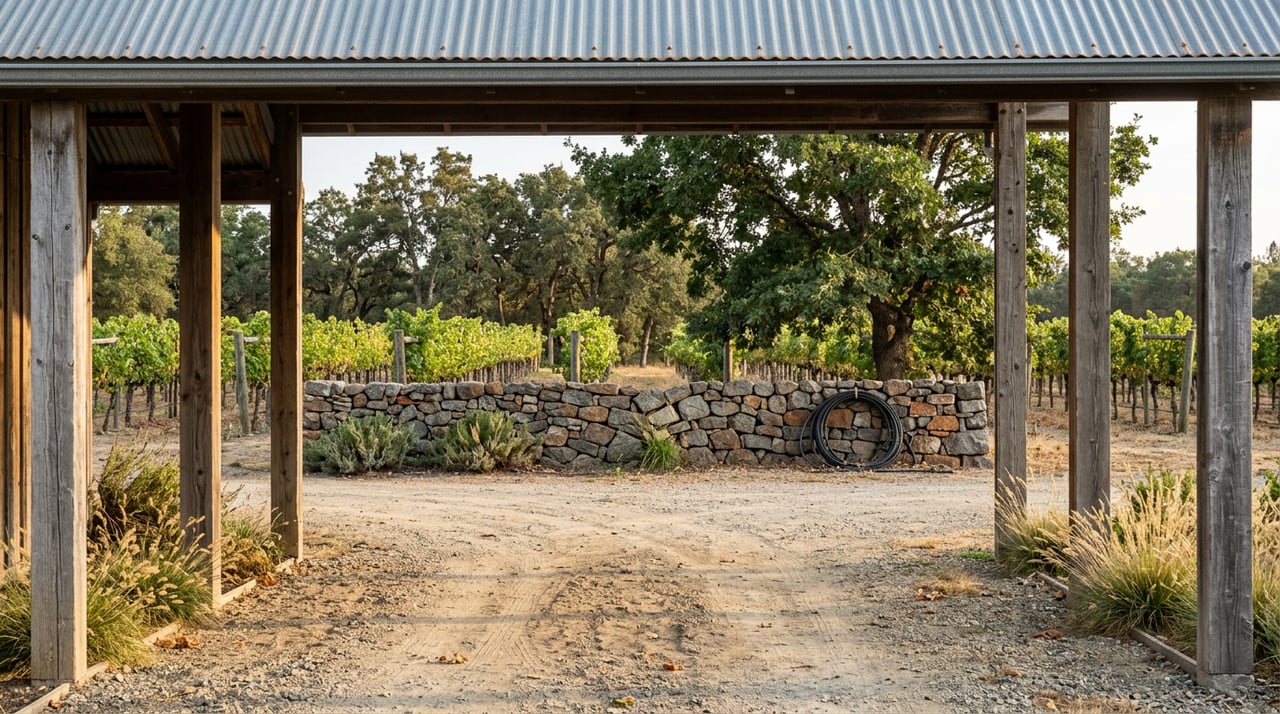
Santa Ynez Valley Land Prices Per Acre and Water Rights
August 13, 2026
August 13, 2026
If two twenty-acre parcels in the Santa Ynez Valley list at the same price per acre, are you buying the same thing twice? Not even close. One parcel might sit inside a water system tied to a reservoir that swung from near-empty to spilling over its spillway within the last decade. The other might run on a private well with no district backup at all. One might carry a decades-old agricultural contract that follows the deed to whoever buys it next. The other might carry no restriction at all. The listing sheet will show you the same number for both.
That number, the price per acre, is the figure most buyers anchor to before they've toured a single property. It's also the figure that tells you the least about what you're actually purchasing in this valley.
As of early August 2026, roughly 43 land properties were listed for sale near Santa Ynez, averaging about $215,539 per acre across the parcels on the market. Pull the same search filtered to farmland specifically, and the average comes in at $205,470 per acre across 29 listings. Those two numbers sit within about five percent of each other.
That's the tell. If agricultural-use land, which almost always carries water and zoning obligations that raw residential acreage doesn't, prices out nearly identically to the broader land market, the sticker price isn't encoding those obligations at all. A buyer scanning listings by price per acre gets no signal about whether they're looking at a parcel with a shared water system and a conservation contract, or a parcel with neither. The average doesn't hide the variable because the variable is rare. It hides it because the market hasn't priced it in consistently, which means the burden of finding it falls entirely on the buyer.
The Santa Ynez Valley's water story runs through one reservoir: Lake Cachuma, formed by Bradbury Dam on the Santa Ynez River. The lake's surface covers about 3,100 acres, but its usable storage is capped at roughly 188,000 acre-feet, down from its original design capacity, because of decades of sediment buildup behind the dam. Five water agencies stretching from Santa Ynez to Carpinteria draw from it.
The lake's history is a lesson in volatility, not stability. Its levels are highly variable, spilling in wet years and dropping below ten percent of capacity in dry ones. A decade ago, in October 2016, the lake fell to 646.42 feet, more than 106 feet below its spillway elevation, a level not seen since the dam was built. The picture has since reversed hard: after a run of storms this past winter, Lake Cachuma reached 101 percent capacity as of January 8, 2026, according to the Santa Barbara Independent.
"We need to balance the lake staying full for water supply and minimize any potential impacts downstream," said Walter Rubalcava of Santa Barbara County's Water Resources Division, describing the ongoing work of managing releases from Cachuma.
Right now, the outlook is favorable. The Santa Ynez River Water Conservation District, formed in 1939 by residents of the Santa Ynez and Lompoc Valleys, states plainly that it is not planning water rights releases downstream of Lake Cachuma during 2026. That's good news for anyone buying this year. It is not a permanent condition. A reservoir that can swing from 10 percent to 101 percent inside a decade is not a system where "the water is fine" is a fact you can bank for the life of your ownership. It's a fact you verify parcel by parcel, because whether a specific property sits inside a district connection tied to that reservoir, or depends entirely on a private well drilled into groundwater with no backup, determines how exposed you are the next time the cycle turns dry.
Some parcels solve this differently. Private developments in the valley, including communities like Rancho Ynecita, are built around a shared association water system rather than an individual well or a municipal tie-in, which is its own answer to the reliability question, with its own tradeoffs around HOA governance and infrastructure costs.
The second variable hiding inside that per-acre number is whether the parcel carries a Williamson Act or Farmland Security Zone contract. Santa Barbara County's Agricultural Preserve Program enrolls land under these contracts, restricting it to agricultural, open space, or recreational use in exchange for a property tax assessment based on what the land actually produces rather than what it could sell for on the open market.
The tax benefit is real. A Farmland Security Zone contract, a stricter version of the standard Williamson Act agreement, taxes the property at 65 percent of its agricultural value, which the county describes as 35 percent less than the rate under a standard Williamson Act contract. That's a meaningful annual savings for a working vineyard or cattle operation.
The part buyers skip past is what happens at resale. Agricultural Preserve contracts run with the land. When ownership changes hands, the new owner is bound by the same restrictions the seller signed up for, whether or not that restriction fits the new owner's plans. And exiting a Farmland Security Zone contract isn't a matter of writing a check. Cancellation isn't allowed. Non-renewal is the only way out, which means the clock on ending the restriction starts the day you file the paperwork, not the day you close on the property.
None of this shows up in a price-per-acre figure. A $200,000-per-acre parcel with no contract and a $200,000-per-acre parcel bound to a Farmland Security Zone are two different financial instruments wearing the same price tag.
| Parcel A: District water, no ag contract | Parcel B: Private well, Williamson Act enrolled | |
|---|---|---|
| Water source | Tied to a district connection linked to Cachuma allocations | Independent well, no district backup |
| Property tax basis | Assessed at market value | Assessed at agricultural use value, typically lower |
| Exit flexibility | No use restriction to unwind | Contract binds you and any future buyer until non-renewal completes |
| What changes in a dry year | Exposure follows district-wide allocation decisions | Exposure is entirely about your well's yield and depth |
Neither column is the "right" answer. A buyer planning to build a residence with no farming intentions probably doesn't want Parcel B's tax benefit if it comes with restrictions on use they'll never take advantage of. A buyer planning to run vines for the next twenty years might find the tax savings on Parcel B worth the tradeoff. The mistake is assuming the price per acre already reflects which parcel you're getting.
Before comparing price per acre across listings, get specific answers on two fronts. First, ask directly whether the parcel's water comes from a district connection, a private well, or a shared association system, and ask to see the well log or production history if a well is involved. Second, ask whether the Assessor's Parcel Number is currently enrolled in a Williamson Act or Farmland Security Zone contract, since that status is tied to the APN and searchable through the county assessor's office rather than always spelled out in a listing description.
Lenders underwriting rural and agricultural land already scrutinize water availability closely, so a buyer who shows up with these answers already in hand moves faster through financing than one who is still finding out mid-escrow.
Does every acreage listing in the Santa Ynez Valley carry a Williamson Act contract? No. Enrollment is voluntary on the landowner's part, and plenty of parcels in the valley carry no agricultural contract at all. You have to check the specific APN rather than assume based on location or lot size.
If I buy a property under a Farmland Security Zone contract, can I get out of it? Cancellation is not an option under that specific contract type. Non-renewal is the only path, and it applies to whoever owns the property when the notice is filed, which could be you or a future buyer.
Is water reliability the same everywhere in the valley? No. Reliability depends on whether a specific parcel connects to a district system tied to Lake Cachuma, draws from a private well, or belongs to a shared association system like Rancho Ynecita's. Lake Cachuma itself has swung from near-record lows to 101 percent capacity within the past decade, which is exactly why the source matters more than the season you happen to be shopping in.
The price per acre gets you in the door. It doesn't tell you what's actually attached to the deed or where the water comes from when the next dry year arrives. If you're comparing Santa Ynez Valley parcels and want someone who will pull the Williamson Act status and ask the water questions before you fall for a number, Cheylin Mackahan is glad to help. Let's Connect.
Stay up to date on the latest real estate trends.
Cheylin's extensive work history in a multitude of environments makes her an asset to any transaction. Cheylin attests her success and drive in Real Estate to her wonderful clients; becoming trusting, lasting, fulfilling relationships far beyond the transaction.
Get In Touch To Learn More
801 Chapala St Santa Barbara, CA 93101